Green, Blue, and Beyond
The Spectrum of Hydrogen Production
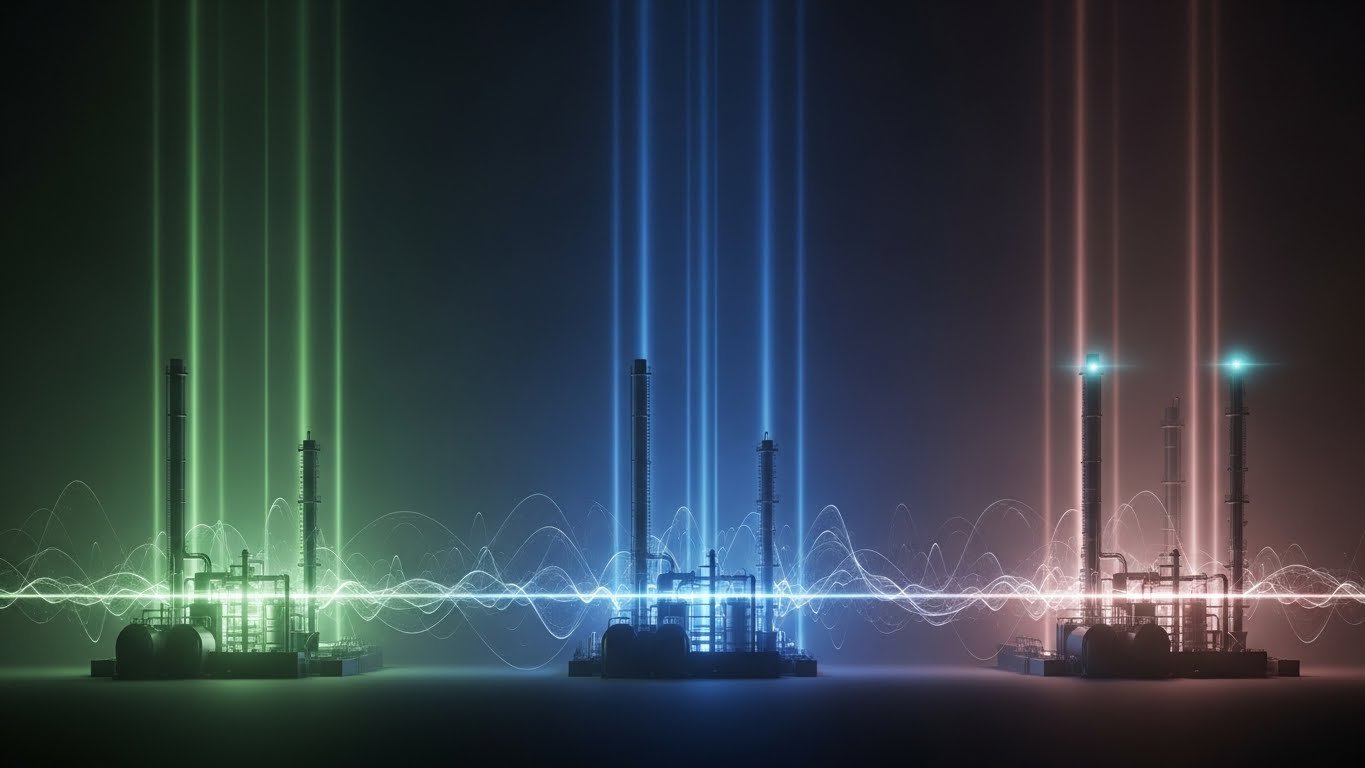
The hydrogen spectrum: Though hydrogen is colorless, its production pathways span a wide range of carbon intensities—from fossil-based methods to fully renewable and emerging zero-carbon technologies.
The Color Palette of a Colorless Gas
Hydrogen is a colorless, odorless gas, but in the world of energy policy and infrastructure, it is described using a vibrant "rainbow." These colors—Green, Blue, Grey, Brown, and even Pink or Turquoise—are shorthand for the production method and, more importantly, the carbon footprint associated with creating the molecule. As we move toward a low-carbon future, understanding this spectrum is critical for investors, engineers, and policymakers.
The Baseline: Grey and Brown Hydrogen
Today, the vast majority of global hydrogen (about 95%) is "Grey" or "Brown."
Grey Hydrogen is produced from natural gas, usually methane ($CH_4$), through a process called Steam Methane Reforming (SMR). While efficient and cost-effective, it releases roughly 9 to 12 kilograms of $CO_2$ for every 1 kilogram of hydrogen produced.
Brown and Black Hydrogen are even more carbon-intensive, created through the gasification of coal (lignite or bituminous). This is the "dirtiest" part of the spectrum, with emissions reaching as high as 19 to 20 kilograms of $CO_2$ per kilogram of $H_2$.
For decades, these methods were the only viable options because they were cheap. However, in a decarbonizing world, Grey and Brown hydrogen are the "problems" that the rest of the spectrum aims to solve.
The Bridge: Blue Hydrogen
Blue hydrogen is often called "low-carbon" hydrogen. It uses the exact same process as Grey hydrogen (SMR), but with a critical addition: Carbon Capture and Storage (CCS). Instead of venting the byproduct $CO_2$ into the atmosphere, it is captured, compressed, and pumped deep underground into geological formations like depleted oil wells or saline aquifers.
The "Blue" pathway is a subject of intense debate. Proponents argue it is a necessary "bridge" because it can be scaled up immediately using existing natural gas infrastructure. Critics, however, point out two major trade-offs:
Capture Rates: Current CCS technology typically captures 60% to 90% of emissions, not 100%.
Methane Leakage: Since Blue hydrogen relies on natural gas, any leaks in the upstream drilling or pipeline process (fugitive methane) can significantly offset the climate benefits, as methane is a much more potent greenhouse gas than (CO2).
The North Star: Green Hydrogen
Green hydrogen is the gold standard of the energy transition. It is produced through electrolysis, a process that uses an electric current to split water ($H_2O$) into hydrogen and oxygen. When that electricity comes from 100% renewable sources—like a massive wind farm or a solar array—the process produces zero greenhouse gas emissions.
The environmental benefit of Green hydrogen is absolute, but the real-world trade-off is currently cost and efficiency.
Cost: Green hydrogen is currently two to three times more expensive to produce than Grey or Blue.
Thermodynamic Loss: Turning electricity into hydrogen and then back into electricity (round-trip efficiency) can result in losing up to 60% of the original energy.
However, much like solar and wind power two decades ago, the cost of Green hydrogen is falling rapidly as electrolyzer manufacturing scales up.
Emerging Shades: Turquoise, Pink, and White
The spectrum continues to expand as technology evolves:
Turquoise Hydrogen: This uses a process called Methane Pyrolysis. Instead of producing $CO_2$ gas, it breaks methane down into hydrogen and solid carbon (carbon black). This solid carbon can be used in tires, coatings, or even buried without the risk of atmospheric leakage.
Pink Hydrogen: This refers to hydrogen produced via electrolysis powered by nuclear energy. It is zero-carbon but faces its own set of social and regulatory hurdles regarding nuclear waste and safety.
White Hydrogen: This is naturally occurring hydrogen found in the Earth's crust. While once thought to be a myth, recent discoveries of large deposits in places like France and Mali have sparked a "hydrogen gold rush." It requires no production energy, only extraction.
Sustainability Implications and Real-World Trade-offs
Selecting a "color" for an infrastructure project is not just a moral choice; it’s a strategic one.
Water Scarcity: Green hydrogen requires high-purity water. For a global economy to run on Green hydrogen, we must consider the impact on local water tables, especially in arid regions with high solar potential. This often necessitates co-locating production with desalination plants.
Resource Dependency: Moving to Green hydrogen reduces dependency on gas-producing nations but creates a new dependency on the "Critical Minerals" needed for electrolyzers, such as iridium, platinum, and nickel.
Infrastructure Readiness: Blue hydrogen can use the pipelines we have today with minor modifications. Green hydrogen often requires brand-new, high-tech infrastructure to handle its unique properties and higher purity requirements.
Conclusion: A Gradual Shift
The future will likely not be just one color. In the near term, Blue hydrogen will likely provide the "scale" needed to build out the trucks, ships, and factories that use hydrogen. As renewable energy becomes even cheaper and more abundant, Green hydrogen will take over as the primary fuel of a truly circular, zero-emission economy.
The "Hydrogen Rainbow" represents our evolution from a carbon-heavy past to a carbon-neutral future—one molecule at a time.
