The hydrogen race
The Global Race for Hydrogen Leadership
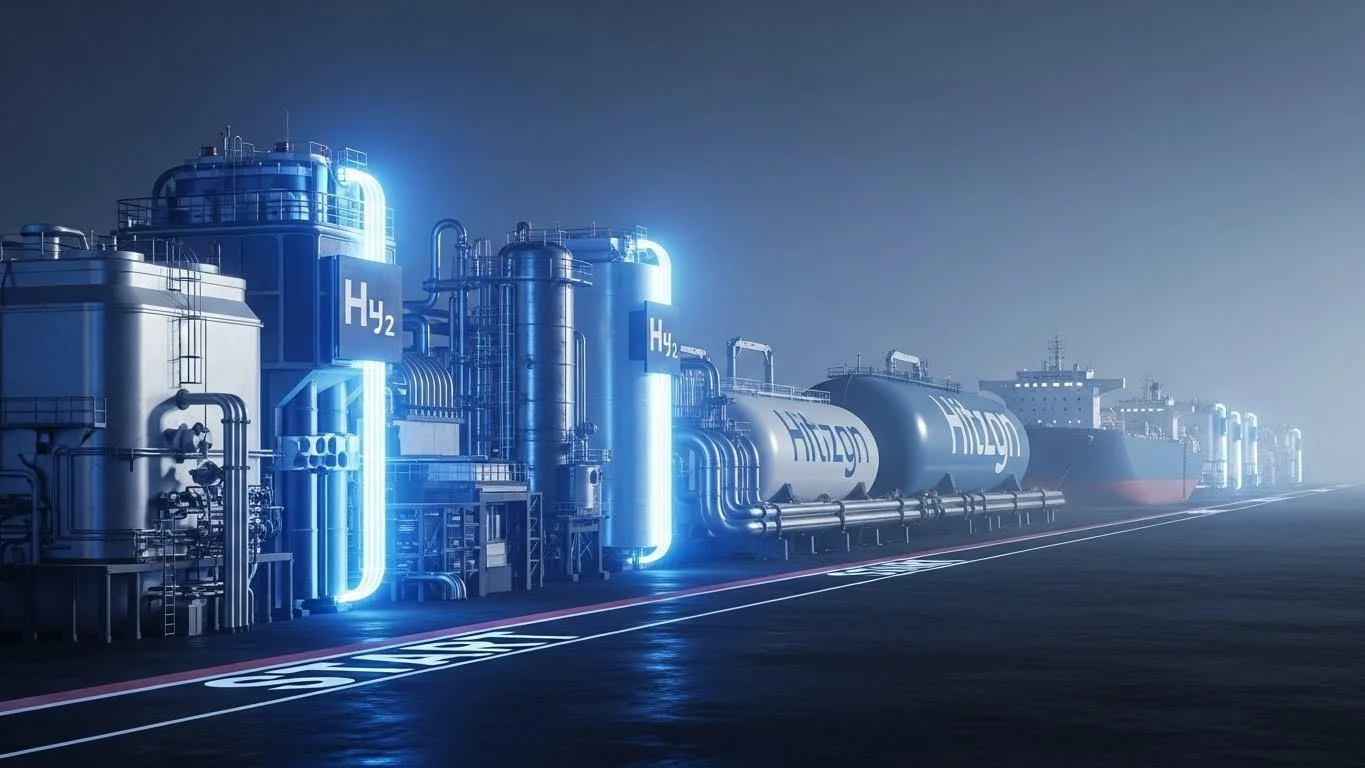
The global hydrogen race begins: Massive hydrogen-powered industrial systems, from electrolyzer plants to pipelines and port terminals, line up like competitors at the starting line—ready to power the future of energy.
The New Geopolitical Map
For over a century, the global map of power has been drawn by the location of fossil fuel reserves. Nations with oil and gas under their soil held the keys to global energy security, while others remained "energy takers." The transition to hydrogen is fundamentally redrawing this map. We are witnessing a "Global Race" that is less about who has the most resources and more about who can master the technology, build the infrastructure, and set the international standards for the 21st century.
As of late 2025, this race has moved from theoretical white papers to massive industrial reality. It is a competition involving three distinct groups: the Early Adopters (who want to lead on technology), the New Superpowers (who have the sun and wind to export), and the Infrastructure Architects (who are building the trade routes).
China: The Scale and Deployment Leader
In 2025, China has emerged as the clear leader in sheer scale. While much of their current production remains "Grey," China's 14th Five-Year Plan recognized hydrogen as one of the six "Industries of the Future." China currently leads the world in electrolyzer capacity, with over 9 GW of projects either operational or in advanced development.
China’s strategy is focused on vertical integration. By dominating the manufacturing of electrolyzers—much as they did with solar panels—China aims to drive down global costs and become the primary technology provider for the rest of the world. In industrial hubs like Inner Mongolia and Ningxia, they are building some of the world’s largest green hydrogen plants, proving that hydrogen can be deployed at a scale previously reserved for coal-fired power.
The European Union: The Policy Architect
If China is the leader in scale, the European Union (EU) is the leader in policy and regulation. Through the "European Green Deal" and the "REPowerEU" plan, the EU has set some of the world’s most ambitious targets: producing 10 million tonnes and importing 10 million tonnes of green hydrogen by 2030.
The EU’s leadership is defined by its "Hydrogen Backbone"—a plan to link 28 countries through a dedicated pipeline network. Furthermore, Europe is leading the "Standards Race." By defining exactly what counts as "Green" or "Low-Carbon" hydrogen through systems like the EU Taxonomy, Europe is effectively setting the rules that global exporters must follow if they want to sell into the world's most lucrative energy market.
The United States: The Incentive Machine
The United States entered the race later but has accelerated rapidly due to the Inflation Reduction Act (IRA). The US strategy is built on "Carrots, not Sticks." By offering a production tax credit (known as 45V) of up to $3 per kilogram of clean hydrogen, the US has made it more profitable to produce green hydrogen in Texas or the Midwest than almost anywhere else on Earth.
This has triggered a massive wave of Final Investment Decisions (FIDs). By the end of 2025, the US has secured over $20 billion in committed investments for hydrogen hubs. The US is also a leader in "Blue Hydrogen," leveraging its massive natural gas reserves and existing carbon capture infrastructure to create a low-carbon energy bridge that can scale faster than pure renewables in the short term.
The Emerging Export Titans: Chile, Australia, and the Middle East
Perhaps the most exciting part of the race is the rise of the New Superpowers. These are nations that were once energy-poor but are now "Renewable Rich."
Australia: With its vast landmass and world-class wind and solar resources, Australia is positioning itself as the "Hydrogen Dock" for East Asia, specifically targeting exports to Japan and South Korea.
Chile: The Atacama Desert has the highest solar radiation on Earth. Chile aims to produce the world’s cheapest green hydrogen (under $1.50/kg) by 2030.
Saudi Arabia & UAE: The Gulf nations are pivoting. The NEOM Green Hydrogen Project in Saudi Arabia is one of the world’s largest, aimed at proving that oil kingdoms can remain energy kings in a post-carbon world.
The Tech Challengers: Japan and South Korea
Japan and South Korea represent the "Demand Side" of the race. Lacking their own space for massive wind farms, these nations are building "Hydrogen Societies." Japan was the first nation to have a national hydrogen strategy (2017) and is leading the world in Fuel Cell Technology and hydrogen shipping vessels. For these nations, hydrogen isn't just a climate goal; it's the only way to keep their high-tech economies running without total dependence on foreign oil.
Conclusion: Who Wins the Race?
The "winner" of the global hydrogen race won't necessarily be the country that produces the most gas. It will be the countries that successfully integrate hydrogen into their existing industrial DNA.
The race is currently in a "Pipeline Clean-up" phase. We are seeing thousands of announced projects being narrowed down to the few hundred with the strongest business cases. As we move toward 2030, the winners will be those who move past demonstration pilots and into full-scale Intelligent Infrastructure. This isn't just a race for energy; it's a race for the economic sovereignty of the next century.
