Hydrogen as Energy Storage
Solving the Intermittency Problem
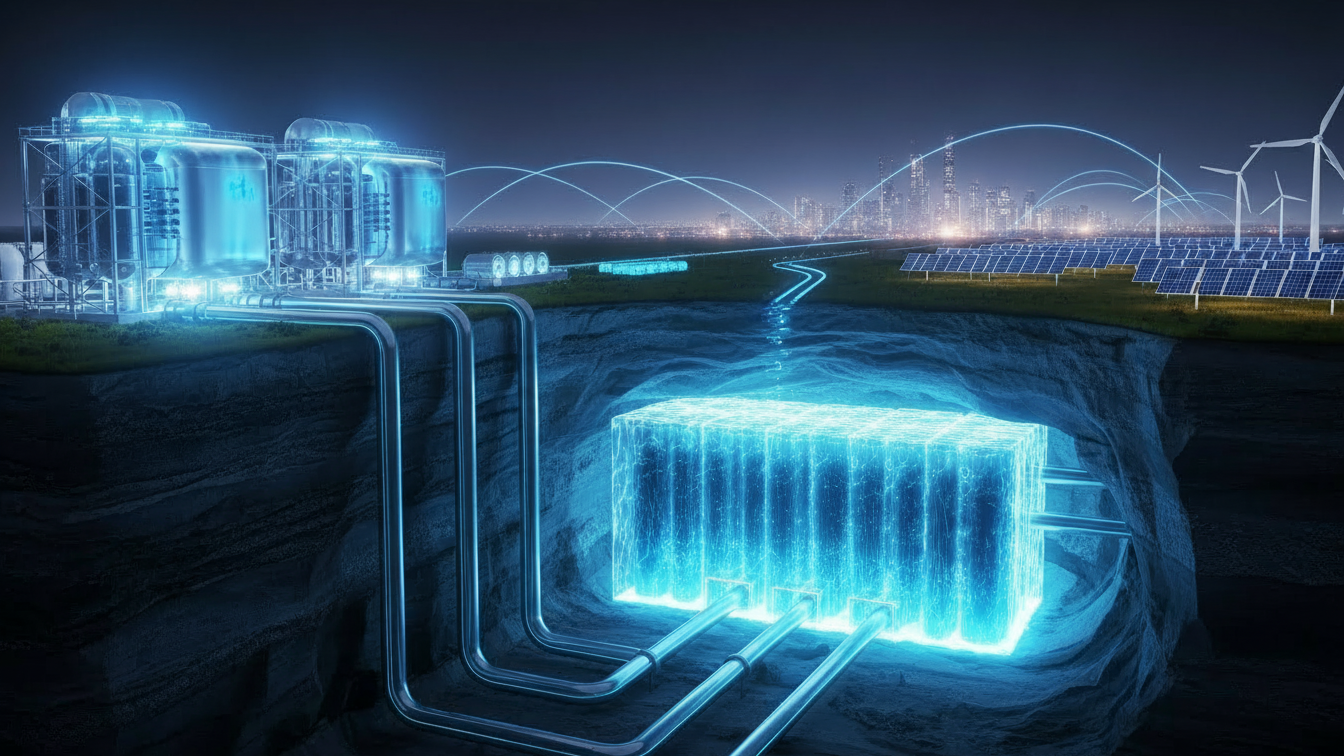
Hydrogen as the Earth’s battery: Renewable energy is stored underground in massive salt caverns and fed to cities, industries, and transport, solving the intermittency problem of wind and solar power.
The Achilles' Heel of Renewables
The transition to a renewable-heavy energy grid faces a fundamental physical hurdle: intermittency. Solar panels do not produce power at night, and wind turbines sit idle during calm weather. Currently, our global energy demand is met by "baseload" power plants (coal, gas, or nuclear) that can run 24/7. To replace these with wind and solar, we need a way to store massive amounts of energy for when the sun isn't shining and the wind isn't blowing.
While Lithium-ion batteries have revolutionized short-duration storage (2 to 4 hours), they are physically and economically incapable of handling long-duration, seasonal, or large-scale storage. This is where hydrogen steps in. Hydrogen is not just a fuel; it is the world’s most versatile "energy reservoir."
The Concept of "Power-to-Gas" (P2G)
The process of using hydrogen for storage is known as Power-to-Gas. It works as a closed-loop system:
Overproduction: During a particularly sunny or windy day, renewable sources often produce more electricity than the grid can consume.
Electrolysis: Instead of "curtailing" or wasting this excess power, it is sent to an electrolyzer to split water into hydrogen gas.
Storage: The hydrogen is stored in pressurized tanks or underground caverns.
Re-electrification: When the sun goes down or the wind stops, the stored hydrogen is fed into a fuel cell or a hydrogen-ready turbine to put electricity back onto the grid.
Short-Term vs. Long-Duration Storage
To understand why hydrogen is critical, we must distinguish between different types of storage needs.
Short-Duration (Minutes to Hours): Batteries are king here. They respond instantly to grid fluctuations.
Long-Duration (Days to Weeks): If a "wind drought" hits a continent for ten days, a battery array would be depleted in hours. Hydrogen, stored in high-pressure tanks, can provide a steady flow of power for weeks.
Seasonal Storage (Months): This is the "Holy Grail" of energy. We can capture the massive solar surplus of the summer months, store it as hydrogen, and burn it for heat and power in the dark of winter. This is physically impossible with current battery technology due to "self-discharge" (batteries lose their charge over time), whereas hydrogen stored in a salt cavern stays there indefinitely.
Underground Salt Caverns: The Earth as a Battery
For hydrogen storage to work at an industrial, "high-growth" scale, we cannot rely solely on steel tanks. We must look to the Earth's geology. Salt caverns—massive underground voids created by mining salt—are the ideal vessels for hydrogen.
These caverns are airtight, can withstand immense pressure, and are large enough to hold thousands of tonnes of hydrogen. A single large salt cavern can store upwards of 100 GWh of energy. To put that in perspective, it would take millions of Tesla Powerwalls to match the storage capacity of one underground salt cavern. Projects like the "Advanced Clean Energy Storage" (ACES) hub in Utah are already being built to turn these geological formations into the strategic energy reserves of the future.
Beyond the Grid: Moving Energy through Space
Storage isn't just about time; it’s about space. Often, the best places to generate renewable energy (like the middle of the Sahara Desert or the coast of Australia) are far away from the cities that need it.
Electric transmission lines lose energy over long distances due to resistance. Hydrogen allows us to "pack up" that energy and move it. We can store renewable energy as hydrogen in one country, load it onto a ship (as liquid hydrogen or ammonia), and "un-store" it in another country thousands of miles away. In this way, hydrogen storage enables a global trade in renewable energy, much like the oil trade of the 20th century.
The Economic Multiplier: Sector Coupling
Hydrogen storage provides a unique economic benefit called "Sector Coupling." In a battery-only world, the stored energy can only ever go back into the grid as electricity. In a hydrogen world, that "stored energy" is a physical gas that can be sold to different markets.
If the grid is full, the stored hydrogen can be sold to a nearby steel mill for industrial use, or to a trucking company for fuel. This flexibility reduces the financial risk for renewable energy developers, as they have multiple "off-ramps" for the energy they harvest. This creates a more stable, investable, and high-growth energy market.
Conclusion: The Resilient Grid
A grid that relies on hydrogen as its primary storage medium is a resilient grid. It is a system that can withstand seasonal changes, geopolitical disruptions, and the inherent variability of nature. By solving the intermittency problem, hydrogen transforms renewables from a "supplemental" power source into a "baseload" power source.
As we build the intelligent infrastructure of the future, hydrogen will be the bedrock that ensures the lights stay on, the factories stay running, and the digital world stays connected—no matter which way the wind is blowing.
