hydrogen’s future
Why Hydrogen Is Critical to a Low-Carbon, High-Growth Future
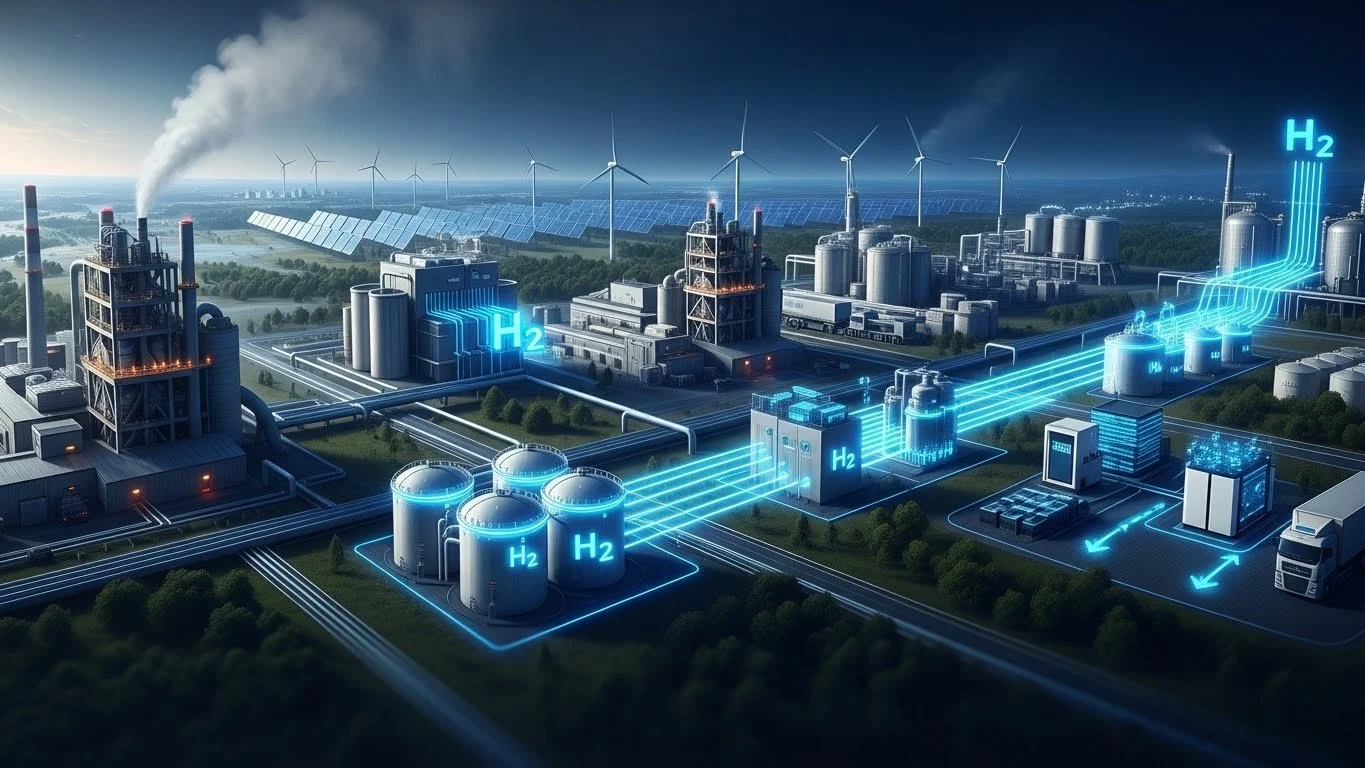
Hydrogen powering the future: Industrial, transport, and digital infrastructure all rely on hydrogen as a zero-carbon fuel, enabling resilient, high-growth economies while supporting climate goals.
The Dual Mandate: Climate and Capital
We are currently living through the most significant energy transformation since the Industrial Revolution. For decades, the global consensus was that economic growth and environmental protection were at odds—to have "high growth," one had to burn more carbon. Hydrogen is the primary technology breaking this paradox. It offers a "Dual Mandate": a pathway to achieve aggressive net-zero climate goals while simultaneously unlocking new industrial sectors and protecting energy security.
To understand why hydrogen is critical, we must look past its chemical properties and view it as a macroeconomic tool. It is the only solution that addresses the "hard-to-abate" 30% of global emissions while providing the resilience that modern high-density economies require to thrive.
Decarbonizing the Industrial Backbone
Direct electrification (batteries and the grid) is the first line of defense against climate change. However, as the "Clean Hydrogen Ladder" illustrates, there are sectors where electricity alone fails. Heavy industry—specifically steel, cement, and chemical manufacturing—requires high-grade heat and chemical reduction processes that batteries cannot provide.
Take steel production, for instance. Traditionally, iron ore is reduced in a blast furnace using coking coal, a process that accounts for nearly 8% of global $CO_2$ emissions. Hydrogen-based "Direct Reduced Iron" (DRI) replaces coal with hydrogen, releasing only water vapor. This doesn't just "clean up" an old industry; it creates a "Green Steel" premium market, allowing industrial nations to maintain their manufacturing base in a world of carbon taxes and environmental regulations. Without hydrogen, these industries would face obsolescence; with it, they face a high-growth renaissance.
Energy Security in a Volatile World
The events of the early 2020s proved that energy security is national security. Relying on a handful of regions for fossil fuels leaves global economies vulnerable to price shocks and supply chain disruptions. Hydrogen offers a path toward Energy Sovereignty.
Because hydrogen can be produced anywhere there is water and sunlight (or wind), it allows nations to "harvest" their own domestic energy. A country like Chile, Namibia, or Australia can transform from a net importer of expensive oil to a net exporter of green energy. This shift reduces the "energy risk" for domestic businesses, stabilizing power costs and creating a more resilient economic foundation. For high-growth economies, predictability in energy prices is as valuable as the energy itself.
Solving the "Stranded Power" Problem
One of the ironies of the renewable energy boom is "curtailment." On very sunny or windy days, solar farms and wind parks often produce more electricity than the grid can handle. Without a way to store that power, it is simply wasted—this is "stranded" energy that represents lost revenue.
Hydrogen acts as a "buffer." Electrolyzers can be switched on during periods of peak renewable production to "soak up" that excess energy and store it as gas. This gas can then be used weeks or even months later. This capability turns an intermittent renewable grid into a reliable, high-growth power system. It ensures that every kilowatt of energy harvested from the environment is put to productive economic use, maximizing the Return on Investment (ROI) for national infrastructure projects.
The New Global Export Market
The Hydrogen Economy is projected to be a multi-trillion-dollar market by 2050. This isn't just about the gas itself; it's about the entire "Value Chain."
Manufacturing Growth: The global demand for electrolyzers, fuel cells, and high-pressure storage tanks is creating a massive new manufacturing sector.
Infrastructure Jobs: Building the "Hydrogen Backbone"—pipelines, export terminals, and refueling stations—requires a massive, skilled workforce.
The Derivatives Market: Hydrogen is being converted into "Green Ammonia" and "e-Methanol," which are becoming the new global commodities for shipping and aviation.
By investing in hydrogen infrastructure today, nations are positioning themselves to capture a share of this $23 trillion global decarbonization market. This is "High-Growth" in its truest sense: the creation of an entirely new asset class and industrial category.
Responding to AI and High-Density Computing
As we move into Article 11 and 12 of this series, we will explore the "Hydrogen-AI Convergence," but it is worth noting here: the digital economy is an energy-hungry beast. AI workloads and data centers require massive amounts of constant, 24/7 power. As grids become more reliant on variable renewables, they risk instability.
Hydrogen fuel cells offer a way to provide "Zero-Emission Baseload" power to data centers. By co-locating hydrogen production with high-density computing hubs, we can power the AI revolution without blowing our carbon budgets. This makes hydrogen the "silent partner" of the digital age, ensuring that the growth of artificial intelligence is not throttled by energy constraints.
Conclusion: The Resilient Synthesis
Hydrogen is critical because it is the only molecule that can travel across the entire economic spectrum—from a heavy-duty truck on the highway to a steel mill in the city, to a data center in the cloud. It provides the Industrial Resilience needed to survive the climate crisis and the Market Opportunity needed to fund the transition.
A "High-Growth, Low-Carbon" future is not an oxymoron; it is a hydrogen-enabled reality. By building the arteries of the hydrogen economy now, we are ensuring that the global infrastructure of the 21st century is as resilient as it is sustainable.
