The Hydrogen Economy
From Scientific Concept to Global Infrastructure
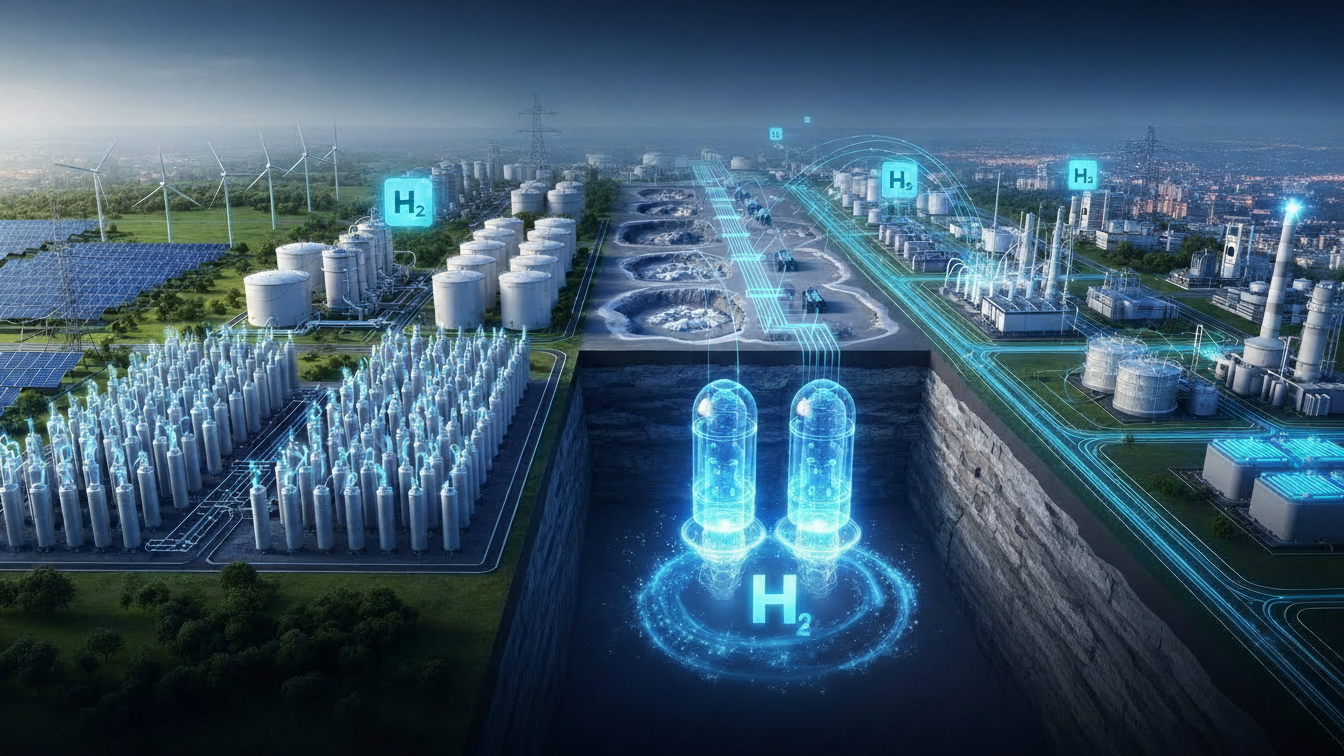
Renewable energy sources feed hydrogen production, storage, and global transport infrastructure—linking wind, solar, industry, and cities into a low-carbon energy system.
The Macro Vision
The "Hydrogen Economy" is not a new idea. It was first coined in 1970 by John Bockris during a talk at General Motors. The premise is simple: replace an economy based on carbon-emitting fossil fuels with one based on hydrogen, the most abundant element in the universe. In this vision, hydrogen acts as the primary energy carrier, linking renewable energy sources like wind and solar to the end-users who need power for their homes, cars, and factories.
Unlike electricity, which must be used the moment it is generated or stored in heavy, expensive batteries, hydrogen can be produced when renewable energy is plentiful (and cheap) and then moved across continents. It represents the "missing link" in the energy transition: a way to transport the power of the sun and wind through pipes and ships.
The Production Engine
To understand the global infrastructure, we must first look at how we get the hydrogen. Currently, the world produces about 90 million tonnes of hydrogen annually. However, most of this is "Grey Hydrogen," produced from natural gas through steam methane reforming (SMR). While effective, this process releases significant CO2.
The shift toward a true Hydrogen Economy depends on "Green Hydrogen." This involves massive arrays of electrolyzers—machines that use electricity to split water (H2O) into hydrogen and oxygen. As the cost of solar panels and wind turbines continues to plummet, the cost of Green Hydrogen is expected to reach "parity" with fossil fuels by 2030. This is the tipping point where the global infrastructure will accelerate.
Storage and the Density Problem
The greatest challenge to the Hydrogen Economy is physics. Hydrogen is the least dense gas in the universe. To store it effectively, it must be either compressed to extreme pressures (350 to 700 bar) or liquefied by cooling it to −253°C.
Global infrastructure is currently evolving to solve this through:
Salt Caverns: Massive underground geological formations can store thousands of tonnes of hydrogen, acting as a national strategic energy reserve.
Liquid Organic Energy Carriers (LOHC): Chemical "sponges" that soak up hydrogen for easy transport at room temperature and release it when needed.
Ammonia (NH3): By combining hydrogen with nitrogen, we create ammonia, which is much easier to ship across oceans using existing chemical tankers.
The Distribution Arteries
Building the "arteries" of this economy involves a choice: build new or retro-fit the old? The world is covered in millions of miles of natural gas pipelines. Engineers are currently testing "blending"—mixing 5% to 20% hydrogen into existing gas lines. However, for a 100% hydrogen economy, we need dedicated pipelines.
The "European Hydrogen Backbone" is a prime example of this infrastructure planning. It aims to create a 53,000 km pipeline network by 2040, connecting hydrogen production hubs in the North Sea and North Africa to industrial centers in Germany and Italy. This infrastructure turns hydrogen into a global commodity, much like oil is today, but without the carbon footprint.
Economic and Geopolitical Realities
The transition is as much about politics as it is about pipes. Countries like Chile, Australia, and Namibia are positioning themselves as "Hydrogen Superpowers" because they have vast amounts of sun and wind. Meanwhile, industrial giants like Japan and Germany, which lack the space for massive renewable farms, are preparing to be "Hydrogen Importers."
This creates a new map of global trade. The Hydrogen Economy promises to democratize energy, allowing any nation with sunlight or wind to participate in the global energy market. It moves us away from a world of "resource scarcity" (where oil is found only in specific spots) to a world of "technological abundance."
The Final Integration
The ultimate goal of the Hydrogen Economy is "Sector Coupling." This means using hydrogen to bridge the gap between different parts of our life. For example, excess wind power from the grid creates hydrogen, which is then used to create "green steel" in a factory, while the waste heat from that process is used to warm nearby homes. It is a circular, intelligent system where nothing is wasted.
As we move toward 2050, the Hydrogen Economy will transition from a scientific white paper to the very foundation of how we power our civilization, ensuring that high-growth economic progress no longer comes at the expense of the planet's climate.
