What Is Hydrogen?
Understanding the Most Abundant Element in the Universe
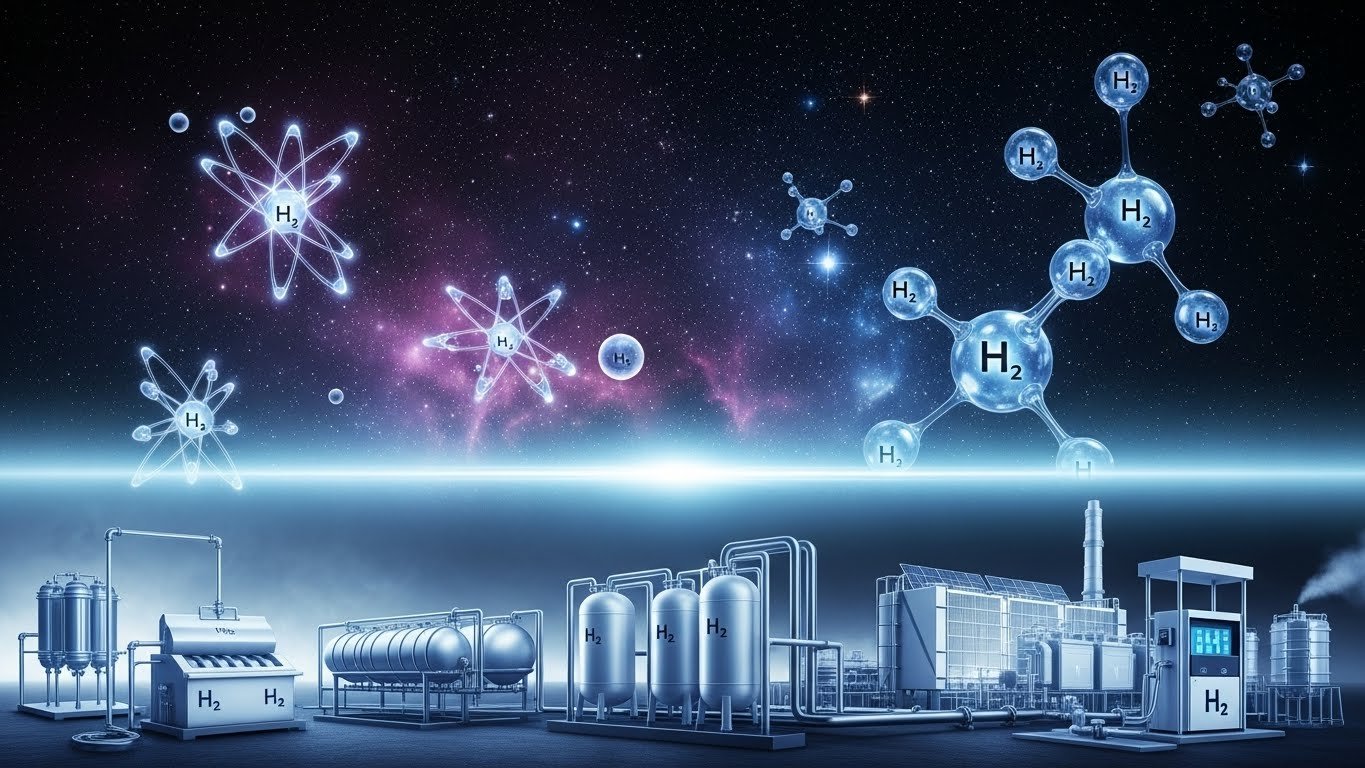
Hydrogen at every scale: From the atomic building block of stars to a cornerstone of future clean energy infrastructure, hydrogen bridges the universe and modern industry.
The Atomic Foundation
Hydrogen is the literal "Number One." It is the first element on the periodic table, the simplest in structure, and the most abundant substance in the known universe. Approximately 75% of all baryonic mass in the cosmos is hydrogen. From the sprawling nebulae where stars are born to the massive gravity wells of the Sun, hydrogen is the primary fuel of the universe.
At the atomic level, a standard hydrogen atom ($^1H$) is elegantly simple: a single positively charged proton at its center orbited by a single negatively charged electron. This simplicity belies its power. Because it is the lightest and smallest element, hydrogen possesses unique physical and chemical properties that make it both a miracle fuel and an engineering challenge. Under standard conditions on Earth, hydrogen exists as a diatomic gas ($H_2$), which is colorless, odorless, tasteless, and non-toxic.
Why Hydrogen is an "Energy Carrier"
A common misconception is that hydrogen is an energy source like oil or coal. In reality, hydrogen is an energy carrier, much like a battery. You cannot go to a "hydrogen mine" and dig it up. On Earth, hydrogen is almost always found in a "committed relationship" with other elements. It is bonded to oxygen in water ($H_2O$) or to carbon in organic matter and fossil fuels (hydrocarbons).
To get pure hydrogen, we must spend energy to break those chemical bonds. However, once the bonds are broken and the hydrogen is isolated, it becomes a potent storage medium. Hydrogen has the highest energy content of any common fuel by weight—nearly three times that of gasoline. This "gravimetric energy density" is why hydrogen has been the fuel of choice for NASA’s space shuttles and heavy-lift rockets for decades.
The Industrial Reality: Hydrogen Today
While the world talks about hydrogen as the "fuel of the future," it is already a massive global industry. Currently, the world produces roughly 90 million metric tonnes of hydrogen per year. However, 95% of this production is used for industrial processes rather than energy.
Ammonia Production: Hydrogen is the critical ingredient in creating ammonia for fertilizers, which sustains roughly half of the global population’s food supply.
Petroleum Refining: Refineries use hydrogen to remove sulfur from crude oil, producing cleaner-burning gasoline and diesel.
Chemical Synthesis: It is a building block for methanol, plastics, and various pharmaceuticals.
The current challenge is that most of this industrial hydrogen is "Grey Hydrogen," produced by Steam Methane Reforming (SMR). In this process, high-pressure steam reacts with natural gas to release hydrogen, but it also releases significant amounts of carbon dioxide. To transition to a sustainable future, we must replace this process with "Green Hydrogen"—using renewable electricity to split water into its constituent parts via electrolysis.
The Behavioral Physics of Hydrogen
Engineering for hydrogen requires a deep understanding of its "extreme" physics. Because the hydrogen molecule is so small, it can diffuse through solid materials that would be airtight for other gases.
Embrittlement: Hydrogen atoms can actually seep into the crystalline structure of metals (like steel pipelines), making them brittle and prone to cracking under stress. This is known as "Hydrogen Embrittlement" and is a primary reason why our current natural gas infrastructure cannot simply be "switched on" for pure hydrogen without significant upgrades.
Buoyancy and Leakage: Hydrogen is 14 times lighter than air. If it leaks, it doesn't "puddle" on the ground like gasoline; it rises and disperses at nearly 20 meters per second. While this makes it safer in open-air environments, it requires sophisticated ventilation and detection in enclosed industrial spaces.
Volumetric Density: While hydrogen is rich in energy by weight, it is very poor in energy by volume. To store enough hydrogen to power a truck for 500 miles, you must either compress it to incredible pressures ($700$ bar) or chill it to a liquid state at $-253°C$ (colder than the surface of Pluto).
Hydrogen as a Pillar of Infrastructure
Why go through all this trouble? The answer lies in Decarbonization. There are "hard-to-abate" sectors of our economy where batteries simply won't work. An international cargo ship cannot be powered by batteries because the batteries would be so heavy the ship couldn't carry any cargo. A steel furnace requires temperatures so high that electricity alone often isn't efficient enough.
Hydrogen fills these gaps. It provides a high-density, combustible, and chemical-reactive fuel that produces exactly zero carbon dioxide at the point of use. When you burn hydrogen or use it in a fuel cell, the only "exhaust" is pure water vapor ($H_2O$).
Conclusion: The Intelligent Transition
Understanding hydrogen is the first step in envisioning the future of infrastructure. It is the bridge between the variable world of renewable energy (sun and wind) and the constant demand of heavy industry and global trade. By mastering the most abundant element in the universe, we aren't just finding a new fuel; we are building a more resilient, autonomous, and intelligent energy system that mimics the very processes that power the stars.
